
The Thing Itself
Notes on Tarr

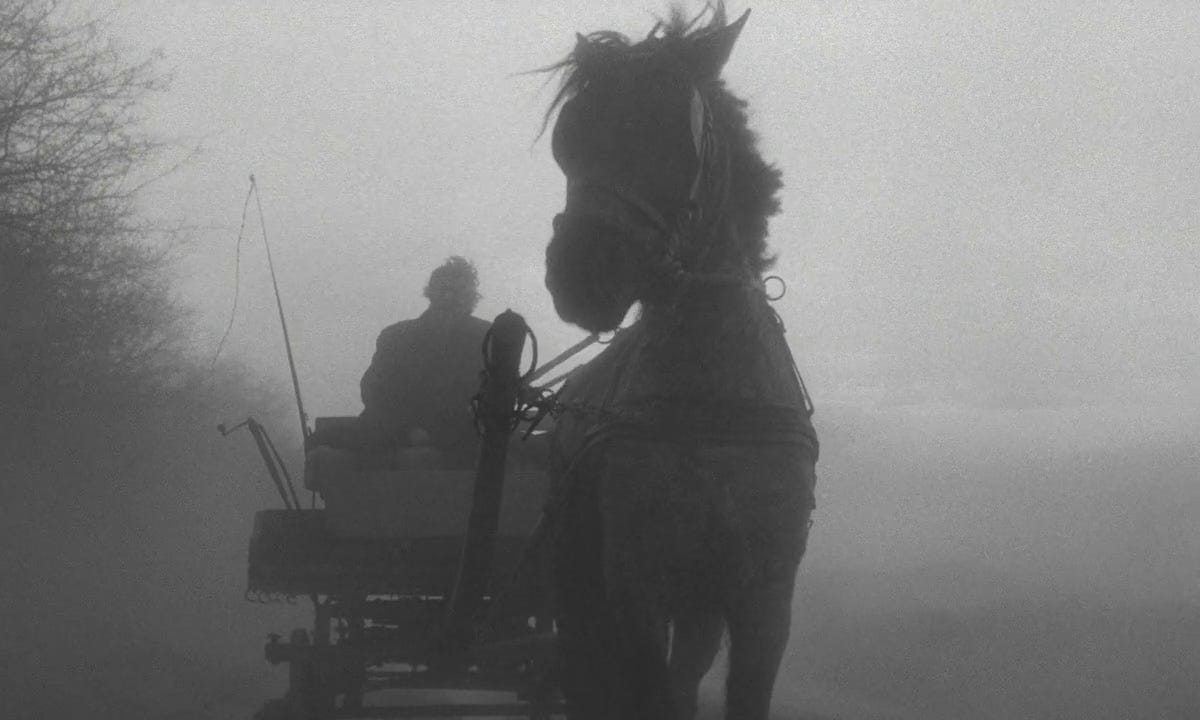
Béla Tarr died today, and the way I felt about the news was not that different from how I felt after watching The Turin Horse in an almost empty theatre in 2011. His films spent twenty years teaching me that the most important things resist being said and must instead be shown, slowly, with the patience of weather, until they settle into the body as a knowing or a keening that no longer accepts words alone. Imagine me saying this, but surprising as it may be, a part of me is made of Tarr too.
My friends and I were lucky to be in our twenties when his films were still arriving. I tried to study them. I ended up drenched in them. Afterward, certain kinds of stimulation that had seemed reasonable began to feel like persuasion, and certain silences that had tested endurance began to feel fertile. Tarr once snapped at an interviewer who wanted metaphors. “Don’t tell me anything about metaphors!” He did not want to give you lossy symbols and bumper stickers you could pocket and carry home. He wanted the plain, the human body, the time it takes to cross a room, the thing itself. He wanted to leave you standing in the wind and the fog long enough that your mind stops shopping for a shorthand, a conclusion, an equation, and becomes porous, nimble, begins to absorb, and learns to hold.
Werckmeister Harmonies poured a town into me. In my bones. Then I just knew how a town thinks, and how it stops thinking. In a bar, early in the film, János takes a room full of drunk old men and, with an innocent, almost mischievous patience, turns them into a solar system. One man becomes the sun, one becomes the earth, as he makes them stand, rotate, eclipse one another, stumbling and laughing and briefly synchronised. A scientific model becomes a bar dance, and you can feel what holds it together. Attention aligned, men in sync, a common picture with spontaneous errors emerging and disappearing as rhythm holds and breaks. Knowledge is carried in the cloud of choreographed bodies for a moment. The scene is tender and it is also a warning, because the same mechanism that lets a gentle man teach the cosmos to drunks with a smile will later let a shadowy figure teach a pogrom with a chant. I am not telling you what Tarr meant. I am just listing the gears it put in me.
Then the whale arrives, already dead, still enormous, still so implausibly alive in its sheer evolutionary ambition that it feels indecent to reduce it to symbol, and yet the town (or some circus) does reduce it, efficiently, by putting it on a truck and selling tickets, because awe, once priced, becomes manageable. I can still see that eye, the size of a human face, and I can still feel what it does to your sense of scale, how it forces you to admit that the universe can be utterly indifferent and still produce a creature of that magnitude, and that we, in our restlessness, might respond with a ticket booth. I don’t want to reduce the enormity of what this scene made me feel by turning it into a lossy allegory. Tarr will turn in his fresh grave if I start unpacking what came to mind when I first saw it… that wonder had entered an economy, that it had become a resource, steerable, that the same crowds that might have stood in wonder before something incomprehensible are now paying for titillation, and the payment is the first step in a longer capture, because once you have learned to approach transcendence through a transaction, you have learned to replace inquiry with narrative, and you have learned the trick to pack a whole town into a truck. This might be why János goes mad. Who knows. But please, let me not unpack it, not tonight. Watch it. The staunch scientist in me is lying low tonight, saying only that let this happen to you, and it will offer neural rewiring that only such cinema can. Stop reading this, I guess. Or don’t. Watch Tarr with my eyes, then, if you must.
So, somewhere in the middle of all this, the uncle explains the Werckmeister tuning, and the film suddenly hands you a key. He is talking about Andreas Werckmeister, the seventeenth-century music theorist whose system made it possible to play in all keys, to modulate freely, to build the entire edifice of Western tonal music. But something was lost. The pure intervals were compromised, microtonal spaces closed off. A living field of acoustic possibility was flattened into a grid that could be taught, standardised, exported. This is what civilisation does. It reduces infinity to a portable scheme, a simplified model so that coordination becomes possible, so that the wheel or penicillin or tax collection don’t need to be reinvented. I personally subscribe to this model. My work is about making maps better, improving their fidelity and function, delivering insight, clarity, maybe inspiring the cure for cancer or poverty, or something like that. But policy also amputates possibility when civilisation mistakes the map for the territory, model for reality, and lives in its tonal trance exclusively. The uncle’s complaint is framed as music theory, but it is a civilisational diagnosis. A neatly engineered abstraction can slowly replace the richer thing it was meant to serve - the range of the possible, the widest menu of options. The town’s collapse begins long before the riot. It begins the moment people accept a thin grid as the whole sky.
Around the whale and its spectacle, a second system forms, darker, faster, built from similar ingredients of seized attention and synchronised bodies. The prince speaks, half in shadow, and what he says matters less than the way his signal lands. The content of the speech is thin. You fill in the blanks. Perhaps he is stirring up the usual ingredients. Rumor, grievance, the pleasure of hating another group, the relief of a world suddenly simplified into us and them. The crowd response is what comes of it. Tarr films it the way a physicist might film a phase transition, without editorialising. So when the riot moves through streets and the hospital like a furious tide looking for a shore, he refuses to give you the usual pleasures. He offers no heroic angles, no cathartic dolly-ins, no cuts to turn violence into entertainment. He gives you only the slow continuous burden of following, so that watching becomes participation, and you cannot later say you did not know where it was all headed.
The mob is operating on a story. Enemies, others, outsiders. Something to purge. The story gives the violence permission. You aren’t beating a person anymore. You are cleansing rot, defending your side, doing what must be done. Tarr doesn’t argue against it. He sets conditions and watches what they produce. Early on he shows you the agents, miserable people, synchronisable people, drunk men who can be arranged into a solar system or a pogrom depending on who is doing the arranging. People who have suffered, who have lived inside flattened maps and mistaken them for the world, who have been handed a story that their suffering has a single cause and the cause has a face. Once that story takes hold, the agents run on their own.
Tarr keeps placing the world in their path. Buildings. They break the buildings. Stores. They break the stores. A hospital. They break the beds, the furniture, the people. Nothing stops them. He keeps feeding the run corridors and rooms, watching to see what might finally refuse the logic. Then a fluorescent bathroom. A naked old man standing in a tub. Everything halts. The violence drains out of the room. The mob dissolves. Tarr doesn’t explain why. I don’t think he knew beforehand either. He holds the shot as if he is learning it at the same speed as we are. Lévinas would say the face commands. Simone Weil would say affliction, truly seen, is sacred. You know me, who am I fooling? I’d be so tempted to talk. Something about group selection or game theory or something novel, useful. Tarr says nothing. He simply holds the shot until it becomes you.
All my work has long takes. When you hold a shot and let the camera drift through a scene, you start to feel like you are discovering it the way a human gaze would, not being shown the room by an editor. Tarr’s gaze walks with you, at your pace, and lets you find your own way to what matters.
If Werckmeister is a film about how shared reality can be built, captured, and shattered, The Turin Horse is what remains when reality offers almost nothing to share. The world contracts to a farmhouse, a well, a tree, a road that leads into wind. A father and daughter repeat the same actions across six days, dressing, eating potato, drawing water, looking out, going to bed. The repetition is measurement. Each return to the same task asks the same questions with brutal gentleness. Can the system still run? Can the body still lift? Can the mouth still eat? Can water still be drawn? Can the horse still consent to labour?
The horse, of course, cannot. The opening shot had already told you this, if you were listening with your eyes. A horse advances through fog, one step at a time, pulling a cart, and Tarr holds the take for what feels like geological time, so that you cannot escape into narrative, cannot paraphrase, cannot look away. Labour becomes the scene’s grammar. (Please stop reading and watch this now.) The fog withholds the horizon. Gabor’s mono (yes, not atmos, not seven-point-one, not stereo) sound withholds the horizon. And you realise, slowly, that this is an invitation to share, even briefly, the animal’s tempo, the animal’s cost, the animal’s unnarratable experience of continuing. Nietzsche’s famous Turin anecdote often places the philosopher at the center, the human who collapses, the human whose sanity breaks at the sight of a beaten horse. Tarr recenters the animal. He goes beyond the heroic instant of pity. He asks what is it like to be a creature whose participation was never a choice.
The horse begins to refuse. First it will not pull. Later it will not eat. (Oh, you still want to eat? What? An unboiled potato?) This is the recognition that in a closed system where participation only prolongs extraction without restoring any future worth moving toward, refusal is the first rational act. Agency, in such a world, appears as non-compliance, non-cooperation. The horse is correct. Nietzsche is correct. János from Werckmeister is correct. How could you not lose your mind?
The wind in this film is pressure, ceaseless, scouring, indifferent in the way that the universe is indifferent. The music, Mihály Víg’s cycling theme, is the meter by which the world’s remaining coherence is counted, like a weather pattern, but also mutating. It is a cosmic eulogy, but a prayer too. The Turin Horse does not deliver meaning. It delivers the conditions under which meaning either survives or doesn’t, and it lets you watch the lights go out, one by one, without telling you what to feel about the darkness.
When Tarr retired after The Turin Horse, his sound designer Gábor Erdélyi did not retire. He continued. He became my sound designer, first on Ship of Theseus, then on Tumbbad, and onward. I sought him out because the discipline he carried was the discipline I needed. The belief that restraint is respect for the viewer’s wisdom. He once said to me that if The Turin Horse is the question, Ship of Theseus is the answer. I don’t know if that’s true, and it might be grotesque to put it here, but it’s not from pettiness, not from hubris, just an academic proposition. A film about continuity made right after a film about systems running out of reasons to continue. Well, I know only that the craft traveled, and that I am one of the people it traveled to, and that I wake up today aware that the man who sent it is gone.
During my postproduction of Ship of Theseus, I stayed at Gábor’s sound studio, the rooms where Werckmeister and The Turin Horse had been made audible. There was an entire floor of analog reels, horses and wind and creaks and footsteps, a library of endurance. Gábor told me Tarr once asked for “the sound of life escaping a horse.” Gábor asked what he meant. Pain. Distress. Suffering. Tarr wanted none of that, only the sound of life escaping. So Gábor widened the search. He went to veterinary hospitals. He recorded horses being treated, horses sedated, horses in coma, horses dying. He built the archive. Tarr listened. Tarr said no. None of it was used. The demand was real. The obvious answers were insufficient. Ok, so I am more lenient than Tarr, and I will spoonfeed you the moral of this story. You do not fake the thing you cannot find.
In a culture that perfects simulation and stimulation, that learns to steer consent by engineering feeling before thought arrives, that treats attention as a resource to be captured and sold, Tarr did something almost subversively old-fashioned. He made films that do not beg for your dopamine. He built images that cannot be skimmed. He refused the usual bargain of entertainment in exchange for time, and instead offered a harder trade. If you give these images your full attention, they will change what you are able to notice, they will recalibrate your tolerance for cheap signals. Attention is an instrument. Most of modern life is designed to play it without your consent. Tarr taught you to take it back.
Let me quote Tarr from the interview with Jonathan Rosenbaum I mentioned earlier: “Okay, I try and explain it to you. You know, if you are in the Hungarian plain in the early morning, before the shooting, and you are just sitting there, just watching. And you just watch the perspective. And you don’t know what you see. Is this one endless hopelessness? You really don’t know. Is this eternity or just relativity? That is what I really don’t know. When they are walking, you know, I have the same feeling, always, what is this, is this real distance or we are just…? You know, like a treadmill they are just walking, walking, just endless walking. Do you have perspective, or hope, or just nothing, or always staying there, in one point?”
I met Víg for coffee in Budapest during the postproduction of Ship. He drank alcohol as if it were already evening. At one point he asked why I didn’t invite Tarr for a coffee too. I offered some reverent explanation about institutions and vast worldviews and meeting one mountain at a time. He laughed and asked if I simply thought that Tarr was the greater artist. He was right to tease me.
Before we parted I asked if it was true they had retired. All of them. Hranitzky, Tarr, him. He said it was true. I asked why. He looked at me as if I’d missed the most obvious fact in the room and said, “Have you seen The Turin Horse?” I said yes, several times. He said, “Well then, what’s left to say?”
So beautifully penned! And yet again you've managed to add to my education by introducing me to the world of Tarrv
"Is this eternity or just relativity?" Wow! Thanks for sharing this.